

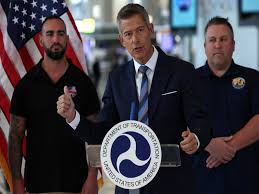
WASHINGTON: US Department of Transportation Secretary Sean P Duffy and Federal Aviation Administrator Bryan Bedford on Thursday (local time) announced Peraton will be the Prime Integrator to lead the most important aviation infrastructure project in decades, according to a statement from the Federal Aviation Administration.
The organization, in tandem with USDOT and the FAA, will oversee the rollout of a brand-new air traffic control system to enhance the safety and efficiency of skies. This project received a historic $12.5 billion down payment from President Donald Trump’s One Big Beautiful Bill, the release stated.
“We are thrilled to be working with Peraton because they share President Trump’s drive to modernize our skies safely at record speed,” said US Transportation Secretary Sean P Duffy. “Working together, we are going to build on the incredible progress we’ve already made and deliver a state-of-the-art air traffic control system that the American traveling public, and our hard-working air traffic controllers deserve.”
“We are taking bold action to ensure our air traffic system is the envy of the world,” said FAA Administrator Bryan Bedford. “The One Big Beautiful Bill gave us a strong $12.5 billion down payment to start this modernization effort. But to finish the job and deliver the safer, more efficient system travelers deserve we’re going to need another $20 billion. This is a long-term investment in the future of air travel, and we’re committed to getting it right.”
According to a statement from the FAA, Peraton’s capabilities are aligned with President Trump’s goal to fundamentally overhaul air traffic control for the better. The company’s expertise with integrating complex tech platforms and successful collaboration with federal government agencies have positioned them well to execute on this ambitious timeline.
Additionally, this first-of-its-kind Prime Integrator contract is structured to reward good performance and incentivize smart usage of the taxpayer dollar. The contract will also penalize unnecessary delays or poor performance.
While Joe Biden and Pete Buttigieg complained the modernization of the nation’s air traffic control system would take over ten years, the Trump Administration is on track to complete the project in just three. Once finished, the system will reduce outages, improve efficiency, reinforce safety, and support future growth of the national airspace, the FAA said in the release.
According to the FAA, since taking office, President Trump and Secretary Duffy have made huge strides in improving US air traffic control which includes: converting one-third of copper infrastructure to modern fiber, satellite and wireless; deploying 148 radios across facilities nationwide; installing first next-generation voice switch at Allegheny Tower; deploying surface awareness systems to 44 towers and deploying electronic flight strips to 13 towers.
To meet the ambitious goal of implementing a new system by the end of 2028, the Department of Transportation and Federal Aviation Administration used an innovative and first-of-its kind federal procurement contract to expedite selecting an integrator.
The FAA further said, “Our system is safe but our equipment is old. To maintain safety, we slow flights when equipment failures occur. The FAA is experiencing significantly more equipment issues today than in the past. The new system will provide new and more reliable systems that will reduce equipment-related delays throughout the National Airspace System (NAS).
The Prime Integrator will oversee this new approach to innovation, providing centralized leadership to ensure change happens in a coordinated, effective way. They will guide the modernization effort, keep it on track, and support the FAA as new capabilities and technologies are deployed across the NAS.
The project includes replacing core infrastructure including telecommunications networks, radar, software and hardware to support modern air travel.
Peraton will begin work immediately, partnering with the FAA on initial priorities which include transitioning the system’s remaining copper infrastructure to modern fiber and establishing a new digital command center.
“We will continue advancing other modernization initiatives including buying new radar systems and development of next-generation facilities as outlined in the One Big Beautiful Bill,” the FAA said.