

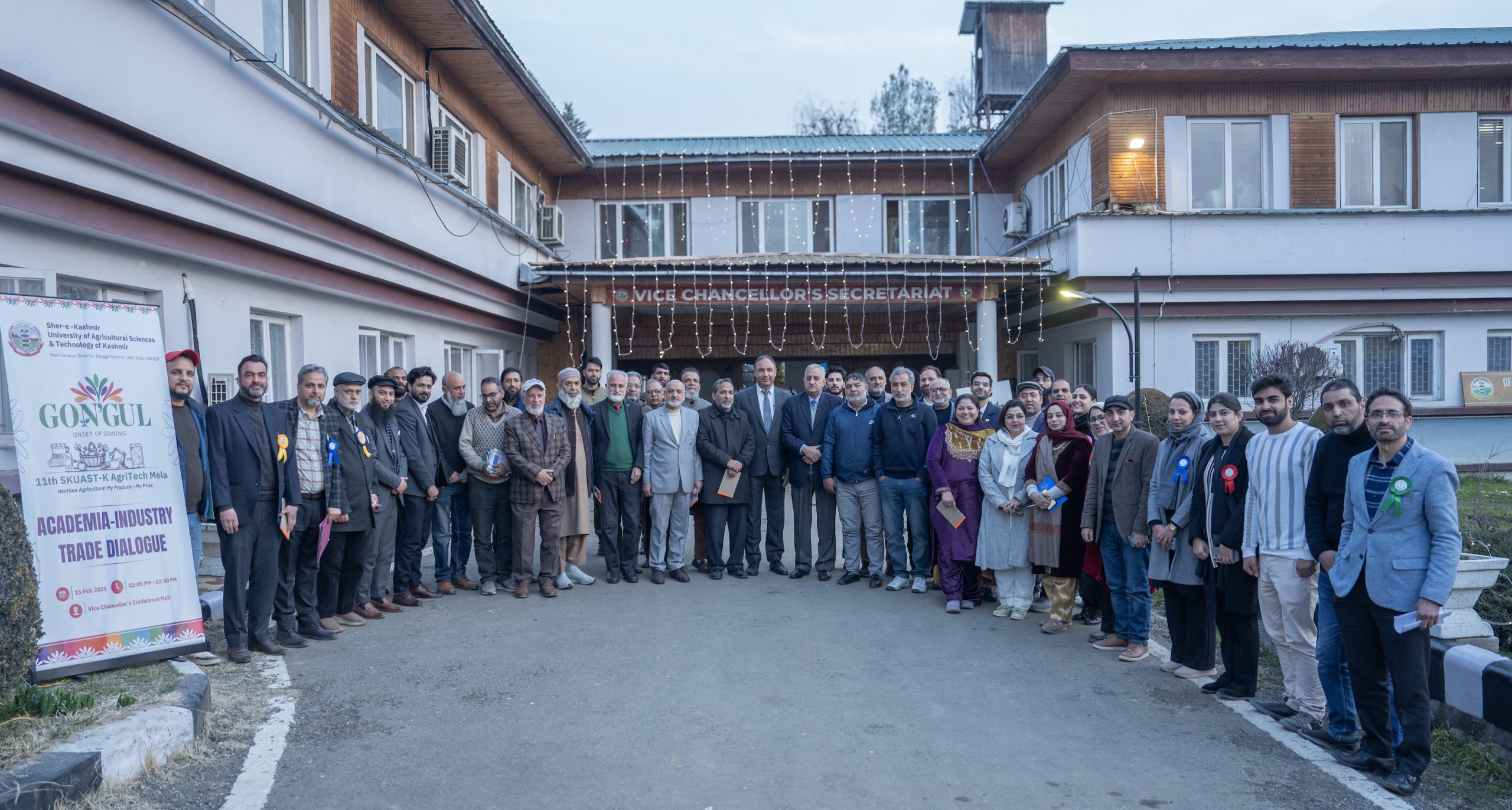
SRINAGAR: In a significant stride toward fortifying the regional economy against both global and local headwinds, Sher-e-Kashmir University of Agricultural Sciences and Technology of Kashmir hosted a landmark Academia–Industry Trade Dialogue during its 11th annual Technology-cum-Trade Fair, Gon’gul 2026.
The meet saw an overwhelming response from a diverse spectrum of society, bringing together prominent trade body members, leading industrialists, influential civil society members, academicians, and senior bankers to collectively chart a roadmap for Jammu & Kashmir’s economic resilience and environmental sustainability. The dialogue was set against a challenging global landscape characterized by geopolitical tensions, trade volatility, and segmented supply chains, with SKUAST-K leading the effort to identify actionable insights for a more diversified regional economy.
The session commenced with Prof SH Baba, who welcomed the dignitaries and underscored the value of high-level interdisciplinary discussions in the current economic climate. Prof. Farhat Shaheen opened the formal dialogue with a comprehensive overview of the meeting’s objectives, emphasizing the urgent need for a collaborative approach to create a resilient ecosystem. He flagged critical issues such as the sensitivity of the tourism sector and existing infrastructural deficits, calling for a policy-oriented framework to address structural gaps. This paved the way for the keynote address by Vice-Chancellor Prof. Nazir A. Ganai, who articulated SKUAST-K’s ambitious vision of leading the charge toward Viksit Bharat @ 2047. Prof. Ganai shared the success of the university’s unique education model, which has transitioned from traditional academics toward a Skill-Innovation-Entrepreneurship-oriented framework in line with NEP-2020. He noted that while universities are not the sole solution to regional challenges, they serve as vital platforms where industry experts and policymakers can meditate on sustainable solutions, further highlighting the university’s strategic collaborations with premier institutions like IIT Mandi, IIT Bombay, and IISc Bengaluru.
The dialogue transitioned into a spirited panel discussion moderated by Prof. F.A. Shaheen, where experts tackled sector-specific challenges and proposed immediate solutions. A primary focus of the deliberation was the identification of unique selling propositions for domestic products and the enhancement of both productivity and quality to meet global standards. Panelists lauded the Holistic Agriculture Development Programme (HADP) as a transformative milestone that has significantly bridged developmental gaps, though they stressed the need to push these initiatives further to harness the region’s full potential beyond the current baseline. Environmental concerns were also at the forefront, with experts calling for the restoration of natural springs and the promotion of responsible tourism to preserve delicate ecological services.
The discussion further explored required reforms in Health Education Policy to position Kashmir as a global hub for health and education tourism, leveraging the burgeoning bioeconomy. Delegates emphasized the importance of developing stronger linkages to attract donors and high-net-worth individuals to support the scaling of local startups. In his concluding remarks, Prof. Nazir A. Ganai reminded the participants that technical resilience must be paired with moral values and soft skills. He emphasized that building a truly resilient community requires leadership characterized by integrity and character, which will ultimately guide Jammu & Kashmir toward the national goal of becoming a developed region by 2047.