

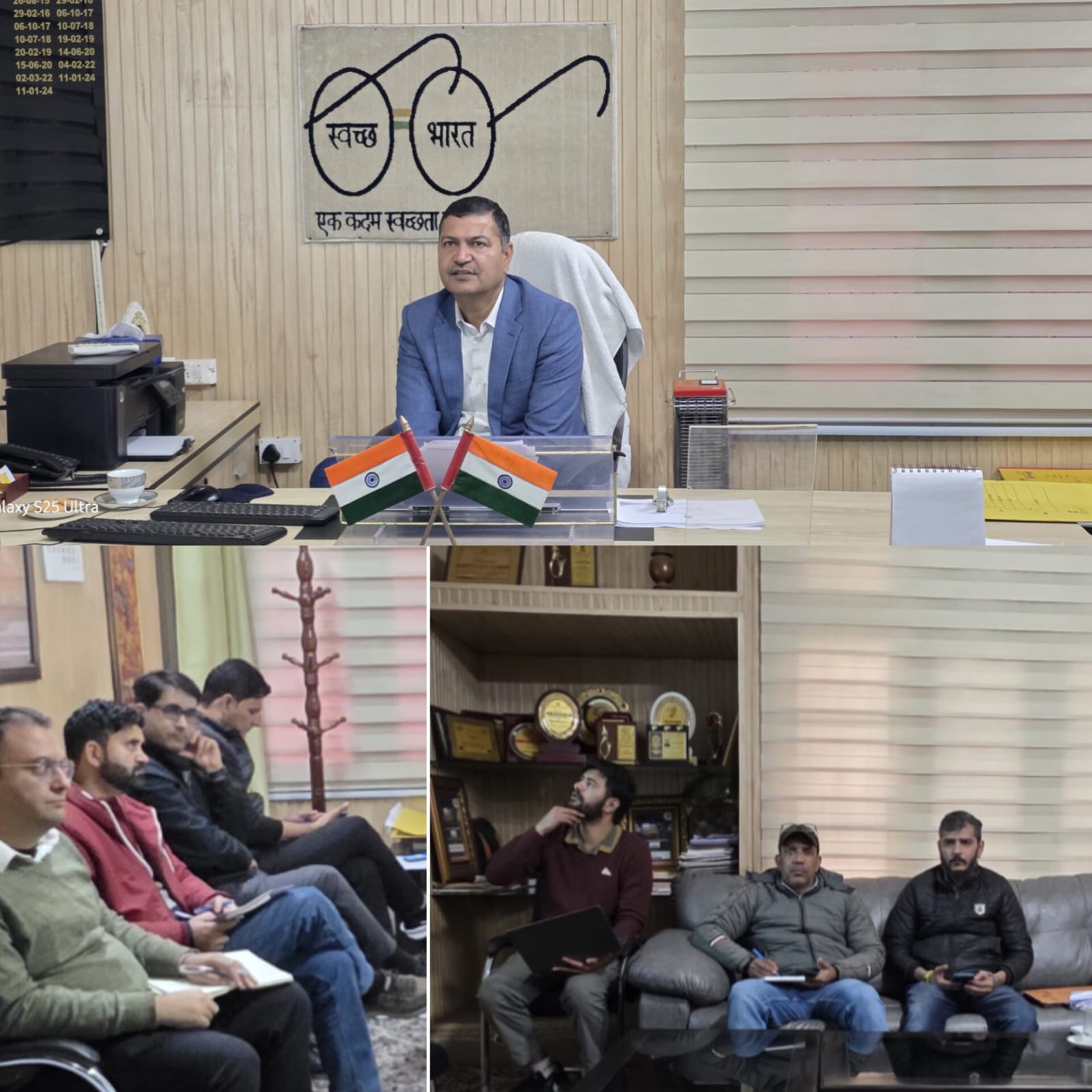
Calls for expedited Panchayat Ghar, sanitation works
SRINAGAR: Director, Panchayati Raj, Jammu & Kashmir, Sham Lal, on Friday chaired a high-level review meeting to assess the implementation, progress and on-ground impact of the Rashtriya Gram Swaraj Abhiyan (RGSA) and the Swachh Bharat Mission–Grameen (SBM-G) across Jammu and Kashmir.
The meeting was attended by Deputy Secretary RD&PR, Tahir Ahmad Magray, Deputy Directors Rural Sanitation Jammu and Kashmir, Assistant Commissioners Panchayats, Executive Engineers and others.
Reviewing RGSA, the Director took a detailed stock of the physical and financial progress of Panchayat Ghars for the financial year 2025–26. He directed officials to expedite execution, particularly in districts where land identification remains a major bottleneck.
Sham Lal directed all Assistant Commissioners Panchayat to accord top priority to the construction of Panchayat Ghars and to hold regular review meetings to closely monitor physical and financial progress.
He further instructed Assistant Commissioners Panchayat and Executive Engineers to ensure timely completion of all ongoing works and to proactively resolve issues related to land identification, tendering delays and administrative bottlenecks to avoid project delays.
On the co-location of Common Service Centres (CSCs), it was informed that 86 percent of the annual target has already been achieved during the current financial year.
While appreciating the progress, he urged field officers to bridge the remaining gap expeditiously to ensure universal digital access across all Panchayats.
The Director said that despite repeated follow-ups, issues related to CSC completion continue to persist. “Where CSCs and additional rooms have already been completed, we should be able to show 100 per cent progress. Any lapse on the part of officials will not be tolerated,” he said.
He also directed that Panchayat Learning Centres (PLCs) be made fully functional and developed as model Panchayat Ghars to promote learning, innovation and best practices and conduct audit as directed by Secretary, RDD&PR.
He also reviewed the PPC (Panchayat Planning Committee) campaign progress and directed all blocks to ensure timely uploading of Gram Panchayat Development Plans (GPDPs) on the e-GramSwaraj portal for transparency and streamlined planning.
Reviewing the performance under Swachh Bharat Mission–Grameen (SBM-G), the Director assessed the progress of Individual Household Latrines (IHHLs), Community Sanitary Complexes (CSCs), Community Compost Pits, Faecal Sludge Treatment Plants (FSTPs), Segregation Sheds, DEWATS and GOBARdhan Biogas Plants.
Emphasizing operational sustainability, the Director directed regular monitoring of Plastic Waste Management Units (PWMUs) and segregation sheds, saying these assets must remain functional and actively used by communities rather than existing only on paper. He underscored that effective waste segregation and plastic management are critical to achieving long-term cleanliness goals in rural areas.
The Director further instructed officials to intensify efforts to convert Non-ODF model villages into ODF Model Plus villages, laying emphasis on sustained behaviour change communication, community participation and adequate infrastructure support. He said achieving ODF Plus status is not merely about construction, but about maintaining hygiene standards and changing mindsets at the grassroots level.
Reiterating the government’s commitment to sanitation, the Director called upon field officers to ensure effective implementation, close monitoring and timely completion of all SBM-G components to strengthen rural sanitation and environmental sustainability across Jammu and Kashmir.
Meanwhile, Ministry of Social Justice and Empowerment (MoSJE) has initiated the rollout of the NAMASTE Scheme in rural areas of Jammu & Kashmir as part of the next phase of implementation for the waste picker target group, including waste collectors, ragpickers, sorters, helpers etc.
It was threadbare discussed in the meeting that the next step includes the commencement of profiling in rural areas and extending the scheme benefits to the target group.
During the meeting, Prakshi, State Coordinator, briefed officials on the objectives of the scheme and the key next steps for effective implementation.