

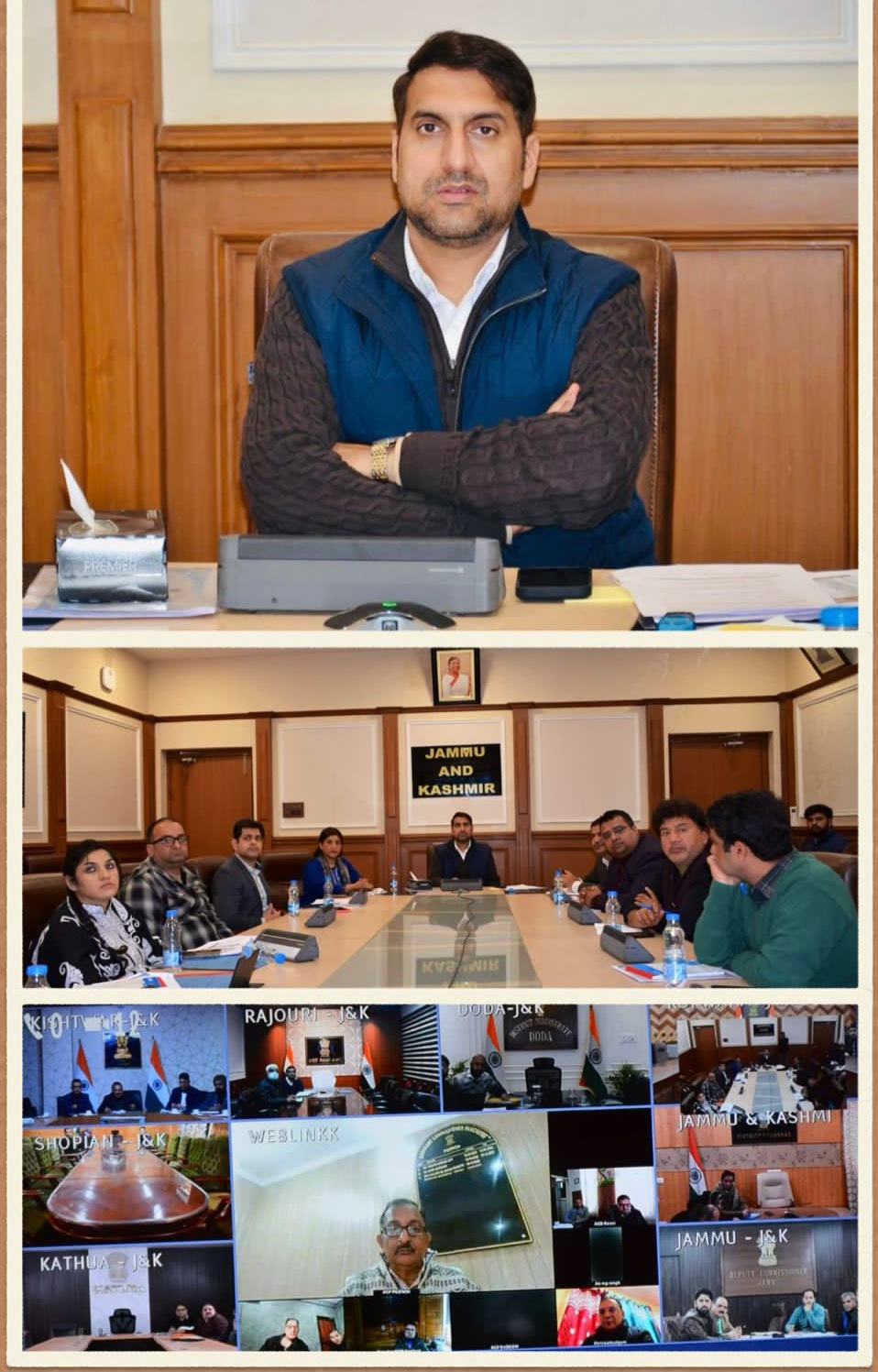
JAMMU: Secretary, Rural Development Department (RDD) and Panchayati Raj, Mohammad Aijaz Asad, today chaired a high-level review meeting to assess the implementation, progress and on-ground impact of the Rashtriya Gram Swaraj Abhiyan (RGSA) and the Swachh Bharat Mission–Grameen (SBM-G) across Jammu and Kashmir.
The meeting was attended by District Development Commissioners from various districts, Director RDD Kashmir Shabir Hussain Bhat, Director Panchayati Raj Sham Lal, Director RDD Jammu Shahnaz Akhter, Deputy Secretary RD&PR Tahir Ahmad Magray, Deputy Directors Rural Sanitation Jammu and Kashmir, Superintending Engineers REW Jammu and Kashmir, Assistant Commissioners Panchayat, Executive Engineers and other concerned officers.
Reviewing RGSA, the Secretary took a detailed stock of the physical and financial progress of Panchayat Ghars for the financial year 2025–26. He directed officials to expedite execution, particularly in districts where land identification remains a major bottleneck. Data presented during the meeting revealed that while the Kashmir Division has achieved 99 per cent land availability, the Jammu Division stands at 72 per cent, with districts such as Jammu, Poonch and Ramban facing significant shortfalls.
The Secretary directed District Development Commissioners to fast-track land identification for the remaining Panchayats and ensure early resolution of bottlenecks. He also advised exploring relocation options in cases where suitable land is not available within the Panchayat jurisdiction.
Emphasising timely execution, the Secretary instructed all DCs to accord top administrative priority to the construction of Panchayat Ghars and to conduct regular district-level reviews to closely monitor both physical and financial progress. He further directed Assistant Commissioners Panchayat and Executive Engineers to ensure timely completion of all ongoing works and to proactively address issues such as land disputes, tendering delays and administrative hurdles to prevent project stagnation.
On the co-location of Common Service Centres (CSCs), it was informed that 86 per cent of the annual target has already been achieved during the current financial year. While appreciating the progress, the Secretary urged field officers to bridge the remaining gap expeditiously to ensure universal digital access across all Panchayats. He also directed that Panchayat Learning Centres (PLCs) be made fully functional and developed as model Panchayat Ghars to promote learning, innovation and best practices.
Reviewing performance under SBM-G, the Secretary took stock of Individual Household Latrines (IHHLs), Community Sanitary Complexes, Community Compost Pits, Faecal Sludge Treatment Plants (FSTPs), Segregation Sheds, DEWATS and GOBARdhan Biogas Plants. He issued strict instructions to ACPs and Executive Engineers, stating that any negligence or delay in the completion of works would not be tolerated.
He informed that under the Annual Implementation Plan (AIP) 2025–26, SBM-G has gained significant momentum in tendering sanitation assets. Against a total target of 9,505 SBM-G assets, tenders have been floated for 8,873 assets, achieving 93 per cent tendering coverage.
The Secretary directed that all IHHLs and Community Sanitary Complexes be completed within stipulated timelines and properly geo-tagged. He further instructed that targets under Community Compost Pits be achieved, and directed both Directors to personally conduct regular reviews to ensure strict compliance. He stressed that work on all other sanitation components must be expedited, with ACPs ensuring daily field-level monitoring.
Highlighting the national importance of SBM-G, the Secretary noted that the mission is reviewed at the highest levels. He made it clear that lack of seriousness in implementation would not be accepted and asserted that accountability would be fixed, with visible improvements required within the next two weeks.
The Secretary also emphasised the need to accelerate the transition of Non-ODF Model villages to ODF Plus status by ensuring effective solid and liquid waste management, sustained toilet usage and visible cleanliness outcomes at the grassroots level. He directed districts to focus on lagging Panchayats, strengthen behaviour change communication and optimally utilise SBM assets to sustain ODF gains.
Underscoring the vision of SBM-G 3.0, the Secretary said the mission signifies a shift from asset creation to outcome-based sanitation governance, with emphasis on circular economy principles, sustainable waste processing solutions, community ownership, technological integration and robust operation and maintenance mechanisms for long-term sustainability.
Earlier, Director Panchayati Raj Sham Lal made a detailed presentation on RGSA and SBM-G, highlighting physical and financial progress, key achievements and district-wise challenges.