

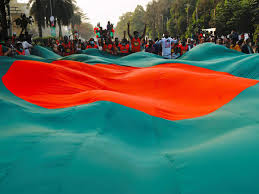
DHAKA: Ahead of the national parliamentary elections in Bangladesh, the political situation has become heated. A leader named Osman Hadi, who was one of the prominent figures in the movement against Sheikh Hasina and a potential independent candidate for the Dhaka-8 constituency, was shot on Friday. His condition is critical. He is also the top leader of a platform called “Inqilab Manch”. This incident of violence has stirred considerable tension in the political arena.
Another significant development in Bangladesh’s politics is that the former Prime Minister Begum Khaleda Zia’s son and the Bangladesh Nationalist Party (BNP)’s Acting Chairman, Tarique Rahman, is returning to the country on December 25 after nearly 17 years of exile in London. BNP Secretary General Mirza Fakrul Islam Alamgir has informed the journalists of this development.
Chief Adviser Prof Muhammad Yunus has said those behind the attack on Sharif Osman Hadi, as well as those who planned it, must be arrested as quickly as possible. He made the remark during an emergency meeting at the state guesthouse Jamuna on Friday night with several members of the Advisory Council and key officials from law enforcement and security agencies, according to the CA press wing.
The chief adviser said the attack on Hadi is one of the most alarming incidents during the tenure of the interim government. He said the attack is a deliberate strike at Bangladesh’s democratic progress. Through this act, the defeated forces have dared to challenge the very existence of the country.
“We will foil any such attempts at any cost. Attacks of this nature on the nation by evil forces will not be tolerated,” he said.
Stating that this attack is part of a conspiracy to derail the national election and the referendum, he added, “Under no circumstances will we allow such conspiracies to succeed. No matter the challenges or storms ahead, no force will be able to sabotage the upcoming election.”
He added, “Together with the people of this country, we will ensure a peaceful election through our collective strength.”
The upcoming national parliamentary election in Bangladesh will be held on February 12, 2026, and a referendum on the “July Charter”, a document of reforms in line with the spirit of the July 2024 movement against former Bangladesh Prime Minister Sheikh Hasina, will also take place simultaneously. The Chief Election Commissioner, AMM Nasir Uddin, announced this schedule. Just a day after the election timetable was declared, the political situation in Bangladesh suddenly became turbulent.
In July 2024, a movement led by students sparked protests against former Prime Minister Sheikh Hasina. On August 5 that same year, Sheikh Hasina fled to India. After that, an interim government was formed in Bangladesh under the leadership of Nobel laureate Muhammad Yunus. Even though the election schedule has been announced, Sheikh Hasina’s Awami League remains barred from political activities, and the Election Commission (EC) has suspended the party’s registration. If the ban is not lifted, the Awami League will not be able to participate in the upcoming election. The Awami League has already rejected the election schedule.
In the upcoming election, the ailing former Prime Minister Begum Khaleda Zia’s BNP are emerging as the main political force. Bangladesh Jamaat-e-Islami, the country’s largest Islamist party, is also a significant contender in the election. Additionally, the newly formed National Citizen Party (NCP), led by the students who spearheaded the movement against Sheikh Hasina, is also participating in the vote. All these parties are now busy forming various alliances.
Right now, one of the biggest challenges facing Bangladesh is holding the upcoming election peacefully. In the country’s history, various incidents of violence have occurred around elections in the past. Moreover, it’s also a significant challenge to ensure that this election is free, fair, credible, and inclusive, as the international community is closely monitoring it this time. India has already called for the election in Bangladesh to be free, fair, credible at home and abroad, inclusive and participatory.