

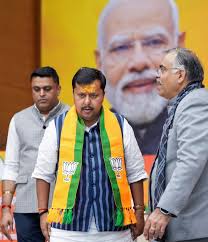
NEW DELHI: When Nitin Nabin took the dais on the BJP high stage this week, everyone looked up and listened. Among the audience was Prime Minister Narendra Modi who endorsed the authority of the BJP’s youngest chief by calling him “the boss”.
As the gathering – comprising the entire BJP senior leadership from union ministers, chief ministers to organisational stalwarts – watched, the former Bihar minister laid bare his agenda for the presidential term.
By the time Nabin, 45, ended his short 20-minute address, it was clear he would focus on four broad themes during his tenure – preservation of Sanatan traditions; anti-infiltration push; youth outreach and perpetuation of Narendra Modi’s politics and personality.
With BJP’s core ideological agendas – Ram Mandir and Abrogation of Article 370 realised – Nabin, as the way forward, gave cadres a call to fight “forces out to destroy Sanatan”. He also peppered his remarks with familiar pro-Hindutva and anti-Article 370 slogans – “Ram lalla hum aayenge mandir waheen banayenge; Jahaan huye balidan Mookerjee woh Kashmir hamara hai; Ek desh mein do vidhan, do pradhan do nishaan nahi chalenge”.
The idea was to send across a message that though the old promises had been kept, the ideological fountainhead for the new ones would stay the same – Hindutva and Sanatan. A particular remark by Nabin stayed with the listeners and resonated with the RSS’ ongoing Hindu unity plan.
This was – “Indian politics should have no space for forces that question the existence of Ram Setu and negate the Deepam (read the controversy over lamp lighting atop a hill in Tamil Nadu’s Madurai).”
References to Sanatan, Somnath, Deepam and Ram Setu echoed the most with the BJP gathering that had congregated at the party’s national headquarters on January 20 to hear their leader.
It was also these remarks that drew the loudest applause, signalling Sangh parivar’s future agenda of consolidation of the Hindus. That the speech of Nabin came alongside the RSS launch of Hindu sammelans across India was no coincidence. It was a clear sign that the BJP and its mothership would marshall forces to galvanise Hindus for which the Sangh recently launched a massive door-to-door outreach across the country.
RSS volunteers plan to reach over 12 crore families across India through their “Hindu Samaj Sammelans” (Hindu society seminars) to be held at over 1 lakh locations.
These seminars in the RSS centenary year will cover 58,964 urban centres of the Sangh called mandals and 44,055 rural centres called bastis – making up an astounding reach of a whopping 1,03,09 locations. Coupled with this will be the RSS griha sampark – house-to-house outreach – which will reach people across villages with the message of “India is a Hindu nation”.
The guidance around the future courses of action came late last year from RSS chief Mohan Bhagwat, who publicly declared that the organisation considered “Hindustan a Hindu Rashtra” and this thought was “non-negotiable.” Bhagwat, however, added that being Hindu did not mean being “anti-Islam”.
Even the anti-infiltration line and messages of action around demographic change first came from Bhagwat in November 2025 when he called for the identification and deportation of illegal immigrants and asked all Indians to consider having three children but no more. It was after the Sangh supremo’s public stance on these issues that PM Modi, Union Home Minister Amit Shah and now the newly elected BJP chief Nitin Nabin have begun assuming aggressive public positions on Sanatan, illegal immigrants and demography. Nabin’s first formal address to BJP cadres echoed all of these messages.