

By: Mushtaq Ul Haq Ahmad Sikander
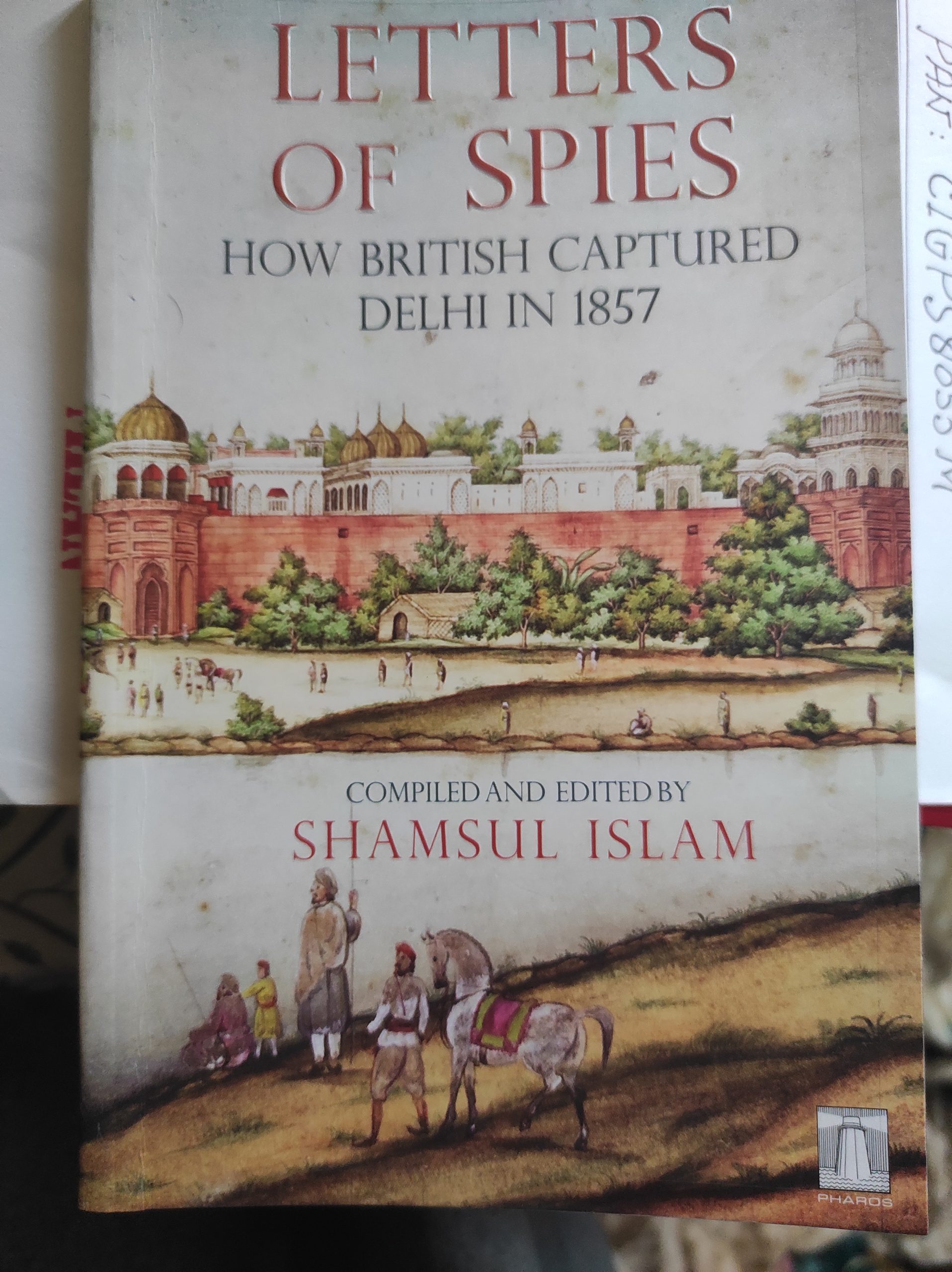
The year 1857 marks one of the most decisive and emotionally charged moments in Indian history—the uprising that burst across the subcontinent and came to be remembered as the First War of Independence. Numerous histories, memoirs, and colonial records have narrated the events of this rebellion from divergent sides, but what remains fascinating is the underexplored world of espionage and information networks that shaped the fortunes of war. Shamsul Islam’s Letters of Spies: How British Captured Delhi in 1857 fills precisely this void. Through a meticulous compilation of original letters exchanged between British officers and their Indian informants inside besieged Delhi, Islam uncovers a chilling dimension of the Delhi Siege (May–September 1857)—a war fought as much through deceit and betrayal as through bullets and bayonets.
In his preface, Shamsul Islam frames the book as a product of “worldwide research,” pointing out that these original letters—which he discovered in colonial archives—reveal how the fall of Delhi on September 20, 1857, owed less to British might and more to the covert operations of spies, informers, and collaborators. Islam echoes a truth familiar to all who study imperial warfare: empires are maintained not merely by military superiority but by networks of complicity. As he writes, “Despite being outnumbered and outmaneuvered by the rebels in Delhi, the British army was able to capture Delhi … only with the help of spies and British stooges present in Delhi.”
“During my worldwide research I came across the original letters of spies from Delhi who were employed by the British or their Indian stooges during their siege of Delhi in May-September 1857. The letters presented here tell a startling and disturbing story. Despite being outnumbered and out maneuvered by the rebels in Delhi, the British army was able to capture Delhi on September 20, 1857. This was made possible only with the help of spies and British stooges present in Delhi. These letters not only throw light on the intrigues of the British rulers but also resolute rebel opposition and their strategies. The rebels appear as victors even though they lost Delhi.”
The parallels Islam draws are historically resonant—the same treacherous pattern that enabled Robert Clive’s victory over Siraj-ud-Daulah at Plassey in 1757 reappears almost a century later in the seizure of Delhi. The tragic consistency of betrayal—from Mir Jafar in Bengal to the anonymous ‘friends’ within Shahjahanabad—suggests that espionage and collaboration were as integral to the British imperial project as violence and subjugation.
Islam’s archival findings allow him to systematize the British espionage machinery within Delhi into three distinct categories.
- First, the “guides,” recruited from among the sepoys of the British Indian Army, infiltrated rebel lines under the guise of deserters or sympathizers. Their military training and familiarity with army routines made their intelligence exceptionally valuable.
- Second, the “harkaras” (literally meaning postmen), consisted of civilian agents hired from the city and its environs. Serving as couriers, observers, and sometimes provocateurs, they carried messages that mapped the geography of rebellion—from food depots and ammunition stores to morale within the ranks.
- Third, and most consequential, were the “old loyalists” of the British—members of the Delhi elite, courtiers, and former officials—the ones Islam identifies as “the most dangerous.” These individuals, motivated by self-preservation, ambition, or old allegiance, held deep influence in the Mughal court and yet served as conduits of British intelligence. Many of the letters reproduced in the book come from these “unknown” figures—unknown only to the public eye, for the British masters, as Islam remarks, “did not wish to disclose their names for obvious reasons.” (P-40-41)
The letters themselves, written in a mix of Persianized Urdu and translated by the editor, bring to life the suffocating atmosphere within Delhi during the siege. The correspondence is astonishingly detailed: the spies reported everything—from the rations available to the rebels, the number of cartridges and gunpowder stores, the position of artillery batteries, even the fatigue levels among sepoys. The British were thus not merely attacking the city—they were virtually present inside it, receiving real-time intelligence through invisible channels.
The figure of Bakht Khan, the key military commander of the rebel forces and a symbol of disciplined resistance, looms large in these letters. His strategies, troop movements, and timing of attacks were being relayed to the British almost daily. Some letters reveal when new reinforcements were expected to arrive from Bareilly; others discuss the exact routes selected for midnight sorties. The spies even informed the British when rations were running low or when soldiers complained of unpaid wages—a psychological insight that the besieging army could exploit. In effect, Delhi was being undone not from outside its walls but from within them.
Portrait of a City under Watch
Beyond its military content, Letters of Spies paints an ethnographic portrait of Shahjahanabad during its final days as the seat of Mughal sovereignty. Through these documents, we glimpse the fragility of an empire caught between its symbolic grandeur and practical helplessness. Islam’s commentary highlights how even as the Mughal court under Bahadur Shah Zafar became a rallying point for rebel unity—Hindus and Muslims alike fighting under the same banner—the rot of betrayal was eating into the foundations.
The letters describe a remarkable sense of communal harmony among the insurgents: Hindu sepoys guarding mosques during prayers and Muslim fighters defending temples—a living rebuttal to colonial narratives of religious division. This unity, however, becomes tragically ironic when seen against the parallel networks of espionage undermining it. The British, ever skilled in the politics of divide and rule, capitalized on this internal surveillance to widen fissures and promote mistrust.
Figures of Treachery and Bravery
One of the central figures emerging from the letters is Mirza Ilahi Bakhsh, a member of Delhi’s royal family and father-in-law to Bahadur Shah Zafar’s son, Mirza Khizr Sultan. Islam identifies him as a clandestine collaborator maintaining contact with British agents even during the height of the siege. His proximity to the emperor allowed him to manipulate information flows, and his betrayal arguably hastened the disintegration of organized resistance.
At the same time, the book does not neglect the moral tenacity of the rebels. Islam’s framing of the story as one where “the rebels appear as victors even though they lost Delhi” reflects his admiration for their steadfastness. The very fact that spies had to risk their lives daily to report on sepoy morale shows how strong and committed the rebellion remained until the end. When spies were discovered, they were executed on the spot by rebel soldiers—an indication of the intense moral consciousness among the fighters who saw collusion as a cancer to be excised immediately.
Material and Emotional Desperation
The letters also document the logistical and emotional exhaustion of a besieged army. Several reports mention sepoys deserting their posts due to unpaid salaries, dwindling rations, and lack of ammunition. The breakdown of command structures, the scarcity of bullet caps and uniforms, and the growing distrust among ranks reveal the human suffering behind the grand narrative of rebellion. There are mentions of boatmen compromised into aiding the British across the Yamuna; of gunners who sabotaged ammunition supplies; and of batteries misplaced due to false intelligence.
Through these details, Shamsul Islam rescues the rebellion from the abstract arena of patriotism and places it within the brutally real world of hunger, betrayal, faith, and fear.
Visual and Documentary Richness
Enhancing the text are the photographs and reproductions included in the book. They visualize various facets of the 1857 conflict: portraits of Delhi’s defenders, crumbling bastions, ruins of Kashmiri Gate, and landscapes of devastation. These images, even when sparse, anchor the letters in material history, bridging the gap between archival evidence and lived experience. They remind the reader that the war was not fought in faceless archives but in blood-soaked streets, in the palaces and alleys of a city that once symbolized Indo-Islamic civilization.
A Study in Imperial Intrigue and Moral Complexity
Islam’s work does more than assemble historical curiosities—it reinterprets the entire fall of Delhi as a case study in the politics of betrayal. His analysis compels readers to reflect on the moral paradox of collaboration: that those most trusted by the people often become instruments of oppression. In comparing 1857’s spies with Mir Jafar’s duplicity a century earlier, Islam connects the dots across India’s colonial experience, revealing collaboration as the empire’s most dependable weapon.
At the same time, the book challenges historiographical complacency. Standard colonial accounts—such as those by John Kaye or G.O. Trevelyan—depict the recapture of Delhi as a heroic conquest by disciplined British forces over chaotic native rebels. Islam’s use of primary intelligence letters turns this narrative inside out: the British succeeded not by virtue of discipline but by corrupting Delhi’s very social fabric. In this sense, Letters of Spies offers a counter-colonial reading of 1857, where the moral victory belongs to the rebels even as they faced military defeat.
Letters of Spies is not an easy read in a moral sense—it forces confrontation with uncomfortable truths about human frailty and the price of disunity. Yet, it is a necessary one, especially for scholars of colonialism and nationalist resistance. Shamsul Islam’s editorial craftsmanship—balancing translation, annotation, and commentary—makes the letters accessible without diluting their raw power.
In the end, the book leaves readers haunted by a paradox. The Mughals’ last stand was crushed by the very networks of trust meant to sustain it, but through that tragedy emerges an enduring image of defiance. The rebels’ courage, their interreligious solidarity, and their tragic fall remind us that even within defeat lies the seed of moral triumph. The spies may have delivered Delhi to the British, but history, as Islam’s work suggests, remembers the betrayed more nobly than the betrayers.
(M.H.A.Sikander is Writer-Activist based in Srinagar, Kashmir and can be reached at [email protected])