

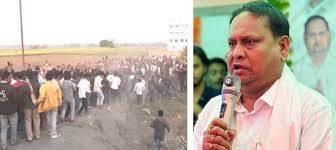
KOLKATA: West Bengal braces for a politically fraught Saturday as suspended TMC MLA Humayun Kabir pushes ahead with the foundation-laying ceremony for a ‘Babri Masjid-style’ mosque in Murshidabad, triggering high alert and sharpened political messaging on a date laden with communal sensitivities.
The Beldanga site, where Kabir claimed “three lakh people” would assemble, has been sealed into a high-security grid, with deployment of RAF, district police, and central forces on both sides of the National Highway 12, after the Calcutta High Court declined to halt the event but placed full responsibility for public order on the state government.
The proposed mosque, which Kabir has repeatedly described as being “modelled on the Babri Masjid”, has stirred political unease in a district where symbolism and mobilisation often feed off each other. For the TMC- which has distanced itself after suspending Kabir- the optics of the foundation-laying ceremony for the mosque on December 6, the anniversary of Ayodhya’s Babri Masjid demolition, carry risks it has sought to pre-empt.
The run-up to the proposed event has forced the administration to arrange for expansive security cover. RAF teams arrived in Rejinagar on Friday and were stationed at a local school ahead of deployment, while the district police – acting on a Calcutta High Court directive to ensure law and order – have drawn up a security grid covering Beldanga, Raninagar and all approach roads to NH-12, the state’s only north-south arterial highway. A senior officer said nearly 3,000 personnel would be deployed throughout the day, with multiple diversion plans ready if turnout threatens to choke the highway.
On Friday, the high court, hearing a petition seeking to halt the event, declined to intervene and placed the onus of maintaining public order on the state government, a cue that prompted the police to talk with Kabir’s team via backchannel on Friday night.
Governor C V Ananda Bose, meanwhile, urged citizens not to be swayed by “provocative statements and rumours” and asked the state to ensure there was “no disturbance anywhere”. For Kabir, a Congress-BJP-turned-TMC rebel whose political career has oscillated as sharply as the reactions to his announcements, Saturday’s event is both a test of his mobilisation prowess and a declaration of defiance after his suspension from the TMC on Thursday for what the party called “communal politics”.
The MLA, who has often embarrassed the party with remarks that triggered showcause notices, said he would resign as legislator and launch his own outfit later this month. On Friday, he was seen personally supervising the stage and food arrangements, appearing unfazed by either the political backlash or the administrative glare.
The scale of preparations has lent the venue the ambience of a massive public fair. A 150-ft-long, 80-ft-wide dais towers over paddy fields off NH-12, with seating arranged for 400 guests. Two clerics from Saudi Arabia, organisers claim, will arrive in a special convoy from Kolkata airport.
Nearly 3,000 volunteers – 2,000 of whom began work early Friday- have been tasked with regulating access roads, preventing bottlenecks and keeping the national highway running. Seven Murshidabad-based catering agencies have been contracted to prepare shahi biryani, with an estimated 40,000 packets for guests and another 20,000 for residents.
A close aide of Kabir estimated food expenses alone at over Rs 30 lakh, with the total venue budget likely to touch Rs 70 lakh.
The day’s programme, circulated by organisers, lists Quran recitation at 10 am, the foundation ceremony at noon, a community meal at 2 pm, and dispersal by 4 pm as per police instructions.
On Saturday, the ruling party will observe ‘Samhati Diwas’ (Unity Day) statewide with rallies to spread the message of communal harmony. The state government has declared a holiday on the day, projecting a message of peace and restraint.
The Left Front, meanwhile, will mark the day as “Black Day” in memory of the demolition, underscoring how December 6 continues to be a political faultline.
As Bengal steps into a Saturday thick with symbolism, security and competing political narratives, Beldanga becomes the stage upon which defiance, faith, politics and electoral calculations converge. Whether the event passes off as a controlled show of strength or becomes a fresh flashpoint will test not just the district’s policing bandwidth, but the political temperature of the state.