

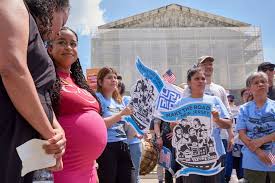
WASHINGTON: US Supreme Court agreed to examine the constitutionality of President Donald Trump’s executive order seeking to end birthright citizenship, reopening a debate widely considered settled since the late 19th century, CNN reported.
By taking up the appeal, the top court has moved beyond the procedural questions it addressed earlier this year–when it sided with Trump on technical grounds related to how lower courts handled the challenges and will now directly consider the policy’s legality.
Cecillia Wang, National Legal Director of the American Civil Liberties Union, welcomed the development, saying the organisation looks forward to the Supreme Court “putting this issue to rest once and for all.”
“The federal courts have unanimously held that President Trump’s executive order is contrary to the Constitution, a Supreme Court decision from 1898, and a law enacted by Congress,” she said.
The Trump administration’s arguments–long viewed as fringe interpretations even among some conservative legal scholars–are expected to draw intense public scrutiny as the court’s term progresses. The case marks another test of the court’s readiness to evaluate an aggressive legal position advanced by the White House.
A ruling in Trump’s favour could overturn a fundamental principle of US constitutional and immigration law, potentially affecting how American parents document the citizenship of newborns. The court is set to hear the matter next year and will likely deliver its verdict by the end of June.
CNN Supreme Court analyst and Georgetown University Law Center professor Steve Vladeck criticised the administration’s stance, calling its attempt to restrict birthright citizenship by executive order “wrong.”
“Whether because it violates the relevant statutes; the Fourteenth Amendment itself; or the Supreme Court’s authoritative 1898 interpretation of that constitutional provision, the bottom line is the same,” he said.
The 1898 ruling in US v. Wong Kim Ark established that individuals born on US soil are citizens, barring a few narrow exceptions. The Trump administration, however, argued before the Supreme Court that this precedent has been misread for over a century.
In its filings, the administration asserted that the understanding of the citizenship clause “was mistaken” and had “destructive consequences.” Ending birthright citizenship has been a central element of Trump’s immigration platform.
Solicitor General D. John Sauer told the court that the Fourteenth Amendment’s citizenship clause was intended to cover formerly enslaved individuals and their descendants, “not the children of temporary visitors or illegal aliens.”
Earlier this year, the Supreme Court issued a key ruling related to Trump’s policy, though that case focused on a procedural question concerning the scope of lower courts’ authority to block presidential actions. In a 6-3 decision, the court curtailed but did not entirely remove the ability of lower courts to halt such policies.